
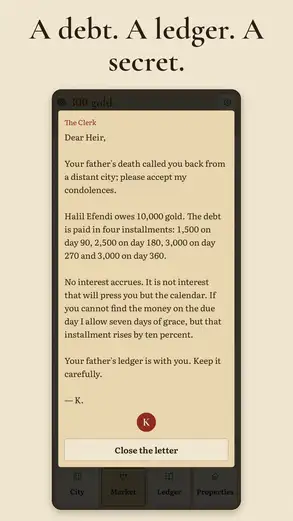
The story
What you see on screen
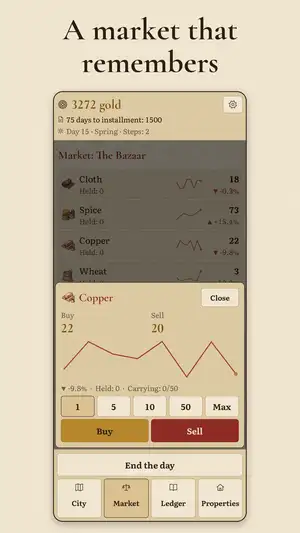
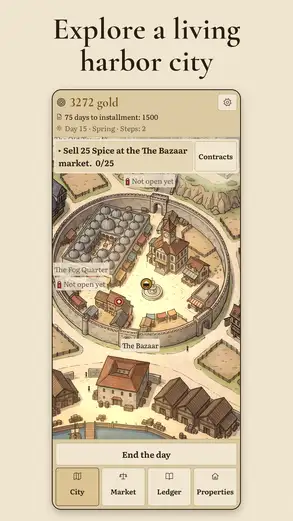
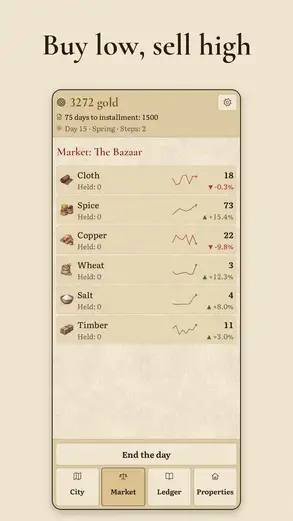
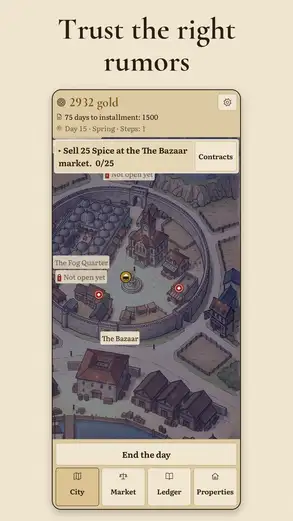
You hold the phone upright. The background is cream paper, the text is ink brown, and the city map looks hand-drawn. Four tabs sit at the bottom: City, Market, Ledger, Properties. At the top you see your gold, the days left until the next installment, and the current day. You get two steps a day; walking to another district costs a step, and so does haggling.
How the trading works
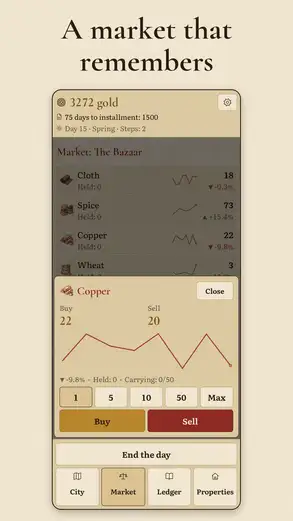
Every district produces one set of goods and wants another. The Bazaar makes cloth, spice and copper; the Harbor makes wheat, salt and timber. You buy where a good is made cheaply and sell where it is wanted. Prices follow the season (wheat is dear in winter and cheap in summer), react to your own buying and selling, and jump with the news.
News arrives with its source: an official notice, a reliable rumor, coffeehouse gossip, or a deliberately planted lie. You decide whom to trust. If you hire an informant (Docker Cemil, Coffeehouse keeper Sabri, the Customs clerk, the Palace servant), he brings news from his own field. You pay him every night, and if you cannot, he sells what he knows to a rival and leaves.
Properties and people
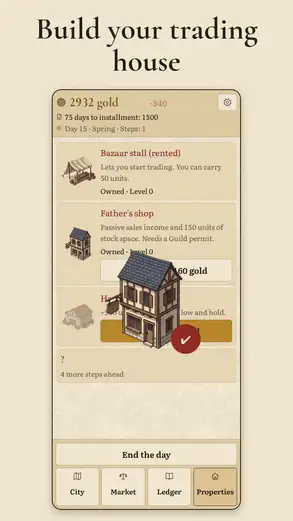
You start with a rented Bazaar stall. Then come Father's shop (it needs a Guild permit), the Harbor warehouse, the Workshop, the Caravan, the Inn and the Moneychanger. In the Workshop you process raw goods: flour from two wheat, a copper pot from two copper and one timber, a chest from three timber, a kaftan from two cloth and one silk, hookah tobacco from two tobacco and one spice. No district produces these; you sell them where someone asks for them.
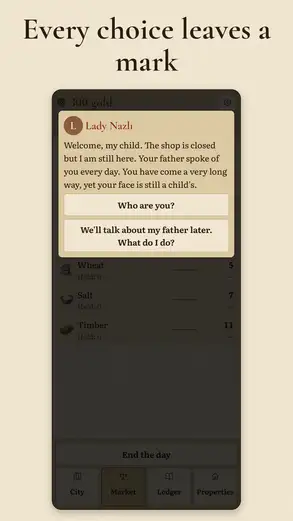
You can hire staff. Apprentice Ali raises your sale prices and wants to learn to read; Clerk Tevfik has a gambling debt; Watchwoman Dilber guards the warehouse; Caravaneer Yusuf softens the losses on the road.
The ledger
Your father's ledger is written in merchant marks instead of letters. It has 12 pages, and the mark-to-letter key changes in every game. Events turn pages up; you tap a mark and guess its letter. Wrong guesses cost nothing, and a mark means the same letter everywhere. As pages are solved you learn why Halil Efendi signed what he signed, and what Master Serçe, Lady Mihri and Kuzgun have to do with it. Your choices are written into a hidden conscience and prosperity tally. At the end one of five endings opens: the Heir, the Confession, the Partnership, the Escape, and a hidden one, the Last Page, if you meet its conditions. The Escape is always available.
Why we built it this way
We left interest out on purpose: the debt is four fixed installments (days 90, 180, 270 and 360), and the pressure comes from the calendar. Bankruptcy does not end the game. It sends you back to the start of the season, and your news history and what you learned stay. There is no account and no connection is required. While you are away your shops earn a little during "silent nights", but story time does not move, so the game does not wait for you and you do not miss anything either. The ads are mostly optional rewarded ones, and a "Remove ads" purchase gets rid of the interstitials.
We wanted the screen to feel like a merchant's ledger: cream paper, ink, seal red and old gold.